How to Decide Between Building or Buying Machine Learning Software for R&D
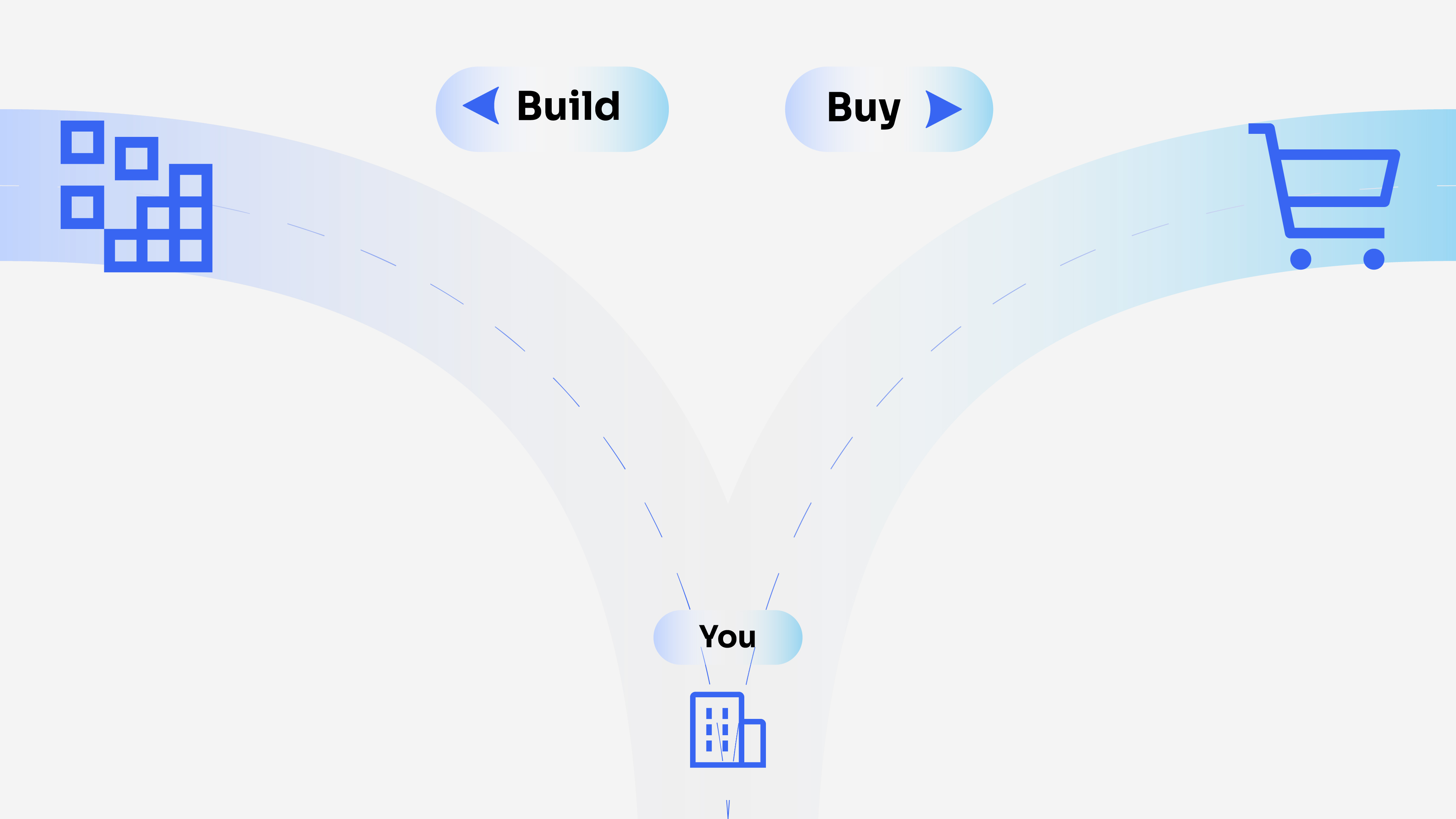
When R&D teams evaluate ML for experimental optimization, the comparison looks simple: develop an internal Bayesian optimization capability using existing headcount, or pay an annual subscription for a commercial platform. The visible cost of building rounds to zero. The hidden cost typically runs $1.2M–$2.5M in year one once full-time-employee (FTE) time, integration, validation, and opportunity cost are accounted for. For R&D directors, that cost shows up as delayed programs, missed milestones, and a team distracted from the work it was hired to do.

Key Takeaways
- Buying a purpose-built ML platform for R&D delivers usable results in 2–6 weeks, with validation, maintenance, and infrastructure managed by the vendor, compared to 12–24 months and $1.2M–$2.5M in hidden costs for an internal build. Even if you already have an internal tool, the development of new functionalities still falls within this timeline.
- Buying keeps your ML engineers focused on modeling problems that advance the science, not platform development and upkeep.
- With a commercial platform, bench scientists get a tool built around how they actually run experiments. No coding required, with dedicated support and ongoing product updates.
- A commercial platform centralizes optimization data across teams, replacing the fragmented methods and siloed results common with internal builds.
- Enterprise security and SOC 2 certification transfer governance burden to the vendor, freeing internal teams from constructing and maintaining those controls manually.
There is no doubt that ML engineers can build an AI optimization platform internally. The question is whether that is the best use of your time and resources and whether it sets the company up for success at scale. If your mission is chemistry, not software development, the answer is clear.
The Hidden Costs of Building ML Software for R&D
The hidden costs of building ML software almost never appear on the comparison spreadsheet at decision time. The visible cost rounds to zero because every input is internal and coded against a pre-existing line. The hidden cost is usually 5–10x the visible one, and it's where most build decisions go sideways.
Loaded FTE cost. Two ML engineers, a domain scientist, and a developer for interface work run $650K–$1.5M per year. At 18 months to production (typical for in-house ML for R&D), that's $975K–$2.25M before the tool produces a single recommendation a chemist trusts.
Integration with the lab. The model that works on a clean spreadsheet doesn't work on the messy data bench scientists actually generate. Integration with ELN systems, lab automation, and batch records is where most internal builds stall. Months evaporate here.
Opportunity cost. While your ML engineers build platform infrastructure, they're unavailable for the modeling work your organization actually needs. The chemist sponsoring the project gets pulled into scoping and troubleshooting instead of running experiments. These losses never appear on the build cost line, but they show up in program timelines and in what you report upward.
Security and governance. Open source tools and internal builds introduce serious compliance risk: no visibility into package maintenance, no audit trails, no enterprise access controls. For regulated R&D environments, this is a compliance exposure, not a theoretical risk.
Adoption failure. The most expensive outcome: the system gets built but bench scientists won't use it. Internal teams optimize for the technical problem they understood, not the workflow problem the lab has. When the developer who built it moves to another role, the code becomes a liability nobody can evolve. For an R&D director, that outcome means defending a seven-figure sunk cost with nothing to show for it.
Why Buying a Purpose-Built Platform Outperforms Building In-House
Your team focuses on chemistry. A purpose-built platform transfers FTE cost, infrastructure overhead, validation burden, and maintenance risk to the vendor. Bench scientists get a tool built around how they actually run experiments, with dedicated support and ongoing updates that keep pace with new methodology.
Your modeling team focuses on advanced modeling requirements: Large corporations consistently have complex, specific modeling needs. Your internal modeling team will continue focusing on those with enough bandwidth, since the commercial tool helps them handle 90% of the day-to-day repetitive optimizations that bench scientists deal with.
Data stays centralized. Buying solves the fragmentation problem that internal builds rarely address. A centralized platform creates a single source of truth across teams and programs, which compounds in value as adoption grows.
Enterprise security is included. SuntheticsML is SOC 2 certified with built-in governance and access controls, compliance that an internal build would require significant engineering effort to replicate.
Results arrive in weeks, not months. Time to usable results drops from months to days. That gap is the actual cost of building.
When to Buy Machine Learning Software for R&D Optimization
For most R&D teams, buying is the lower-risk, faster-to-value path. Build is rational in a narrow set of circumstances.
When Buy Is the Right Call
- Your optimization challenges are problems commercial platforms are built to solve. Reaction optimization, formulation development, biologics media tuning, process scale-up. These are well-mapped problem types with strong commercial solutions available today.
- Your programs run on real deadlines. R&D campaigns run on chemistry timelines, not software development cycles. If your program milestones are fixed, build is not viable regardless of cost. The risk of a failed build falls on the director who approved it.
- Your team's mission is chemistry, not ML infrastructure. Every hour an ML engineer spends on platform maintenance is an hour not spent on modeling problems that advance science.
- You want optimization data centralized across teams. A commercial platform standardizes workflows and gives leadership a consistent view across programs. See how teams have validated results with SuntheticsML in our case studies.
When Build Is the Right Call
- A contained use case owned by a single ML expert. If one expert is using a methodology they fully control in a contained use case, with no expectation of scaling to colleagues or other programs, the marginal cost of building is lower.
- Data residency forbids external tools. If a vendor cannot deploy on-premise or in your VPC, build is the only option.
Conclusion
The build-vs-buy decision is rarely won or lost on the visible numbers. It depends on whether the team making the decision can see below the waterline. For R&D teams whose mission is discovery, not software development, a purpose-built platform is the default rational choice. For R&D directors, that means faster results, lower execution risk, and a team that stays focused on science.
If you want to see what that looks like on a real campaign, contact us to discuss your data and timeline.
Frequently Asked Questions
Why does building ML software in-house cost more than expected?
Because existing headcount and infrastructure feel free at decision time. The cost shows up as opportunity cost and calendar time, which is the most expensive R&D input.
Is open source machine learning software free for R&D teams?
Open-source libraries eliminate license cost but inherit every other hidden cost. They are a build decision in disguise. Beyond limited capabilities and lack of scientist-friendly interfaces, open source carries real compliance risk: no audit trails, no enterprise access controls, and no guaranteed security updates.
When does it make sense to build machine learning software in-house?
When a single AI expert is using a methodology they fully control in a specific, contained application with no plans to scale it across teams. Data residency requirements that prohibit external tools are the one additional case where build has no alternative.
When does it make sense to buy machine learning software for R&D optimization
When your optimization challenges (reaction optimization, formulation development, process scale-up) are problems commercial platforms are built to solve, and your team's mission is chemistry, not ML infrastructure. If your programs can't absorb 12–24 months of tool development, a purpose-built platform delivers faster time to value with lower execution risk.
What happens if you make the wrong build vs. buy decision for ML?
A wrong build decision costs 12–24 months of FTE time, risks a tool that never reaches production, and erodes team confidence in ML for R&D.
References
- Sculley, D., et al. (2015). Hidden Technical Debt in Machine Learning Systems. NeurIPS.
- Brooks, F. P. (1995). The Mythical Man-Month. Addison-Wesley.
- Shields, B. J., et al. (2021).Bayesian reaction optimization as a tool for chemical synthesis. Nature, 590,89–96.
- Frazier, P. I. (2018). A Tutorial on Bayesian Optimization. arXiv:1807.02811.