How to Choose Bayesian Optimization Software for Pharmaceutical R&D

Most R&D leaders evaluating BO software lose six months in the wrong category before they realize they picked the wrong tool. Campaign windows don't recover from that.
Key Takeaways
- There are four credible categories of Bayesian optimization software: open-source libraries, enterprise platforms, internal builds, and chemistry-aware campaign tools like SuntheticsML. Each fits a different situation.
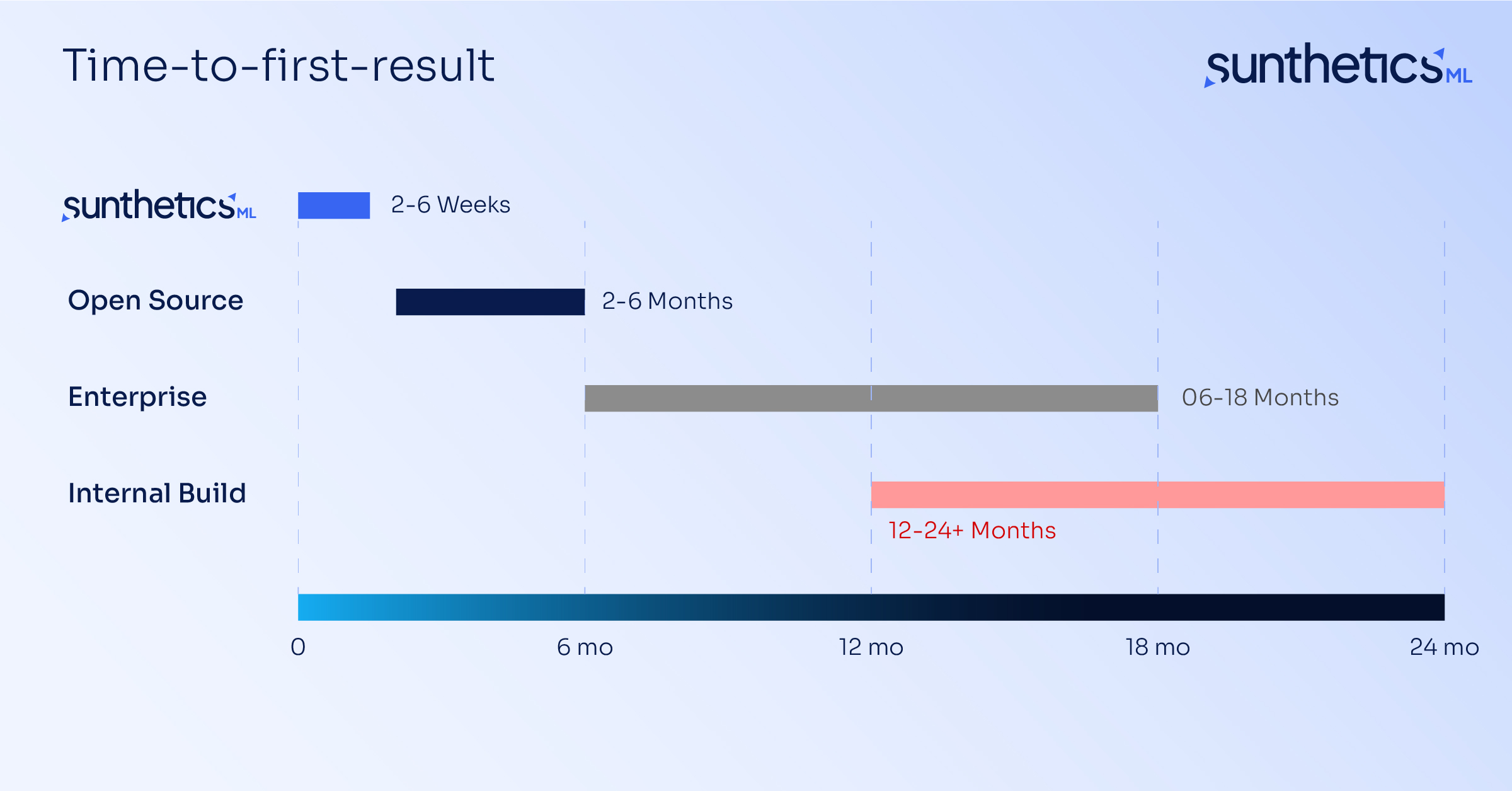
- Time-to-first-result ranges from 2–6 weeks (SuntheticsML) to 12–24+ months (internal build). Most evaluations underweight this dimension.
- Open source is research-grade code, not a production product. You still need the team, infrastructure, integration, and maintenance.
- Four questions determine the right category before any feature comparison matters: campaign cadence, data volume, team composition, and IP/data constraints.
- The worst BO software decision is rarely the wrong vendor. It is the wrong category.
Why Time-to-First-Result Is the Most Important Dimension
If you have already decided Bayesian optimization is the right method for your R&D problem, the harder question starts now: how do you run it in production, on your data, with your team, against your timeline? Most evaluation frameworks focus on features. That is the wrong axis. The constraint is the match between the tool and four things you already know about your situation: campaign cadence, data volume, team composition, and IP and data restrictions.
Most evaluation frameworks for Bayesian Optimization software focus on features. That is the wrong axis
Features are easy to compare on a scorecard and often misleading. Time-to-first-result is harder to measure and almost always more decisive. It is the dimension most R&D leaders underweight at evaluation, and the one their leadership will care about most six months later.
The Four Categories of Bayesian Optimization Software for R&D
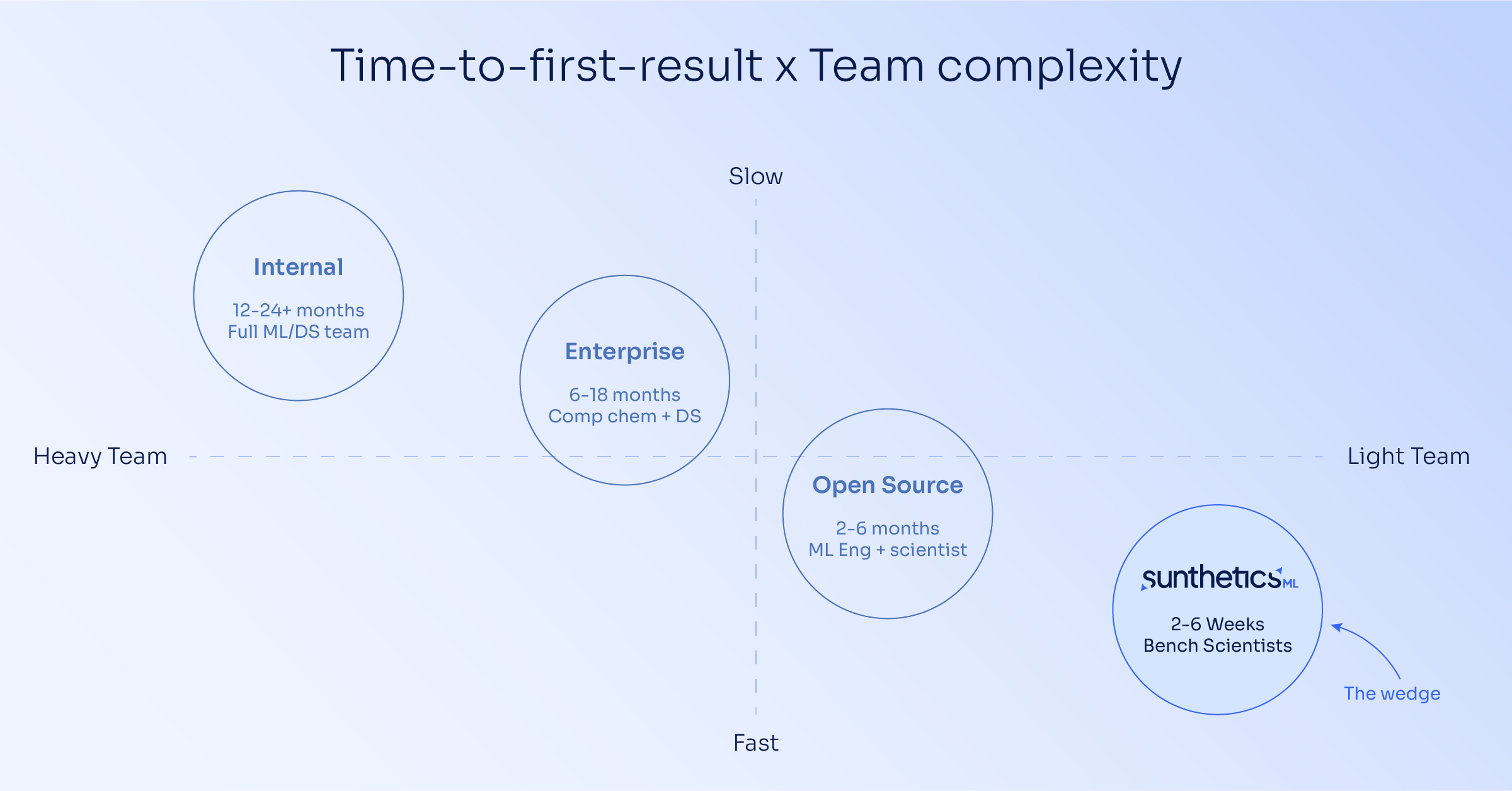
Pick the category before you pick the tool. If a category is disqualified by your situation, no feature comparison within it matters.
1. Open-Source Bayesian Optimization Libraries
The strongest research-grade BO code is open source, and most academic methods originate here. If you are publishing a paper, this is where you start. If you are running a recurring industrial campaign, this is where you stop having a clear answer.
- Time-to-result: 2–6 months.
- Required team: ML engineer + domain scientist.
- Best for: ML-led research groups.
- Min dataset: 30–100+ experiments.
✓ Full algorithmic transparency, no vendor lock-in, chemistry-aware libraries credible in published pharma campaigns.
✗ Research code, not a product — no UI, no scheduling, no audit trail, no support. Typically 6–12 months of senior ML engineer + domain scientist time.
2. Enterprise Bayesian Optimization Platforms
Full-stack discovery platforms — generative chemistry, ADMET, structure-based design, large-scale screening— where BO is one method among many. The right pick if you are committing to a multi-year platform with areal computational chemistry function already in-house.
- Time-to-result: 6–18 months.
- Required team: Comp chem + DS team.
- Best for: Multi-year platform plays.
- Min dataset: Hundreds to thousands.
✓ Mature engineering, deep domain capability, broad infrastructure backed by large engineering teams.
✗ 6–18 month implementation timelines. Suite breadth means buying capability you may not use. Without a deep comp chem function in-house, adoption stalls and the platform becomes shelf-ware.
3. Internal Bayesian Optimization Build
The silent default for organizations that already have an ML function. Hire two or three ML engineers, point the mat an open-source library, give them a few quarters, and build the pipeline yourself.
- Time-to-result: 12–24+ months.
- Required team: Full ML + DS team.
- Best for: Genuinely novel methodology.
✓ Full IP ownership, full control over data flow and architecture, required when data residency rules forbid external tooling.
✗ 12–24 months to a usable production result, headcount routinely underestimated. Internal teams tend to solve the problem they understood at start, not the one the bench actually has six months in.
4. Chemistry-Aware Campaign Optimization (SuntheticsML)
SuntheticsML sits in a deliberately narrow gap: small-data R&D campaigns where you have a target (yield, selectivity, stability, performance), a small dataset (typically 5–100 experiments), and a constraint on how many additional experiments you can run.
- Time-to-result: 2–6 weeks.
- Required team: Bench scientists.
- Best for: Real campaigns with limited data.
- Min dataset: 5–100 experiments.
✓ Bayesian optimization with chemistry-aware parameterization out of the box. Native multi-objective Pareto, batch design, and constraints. Used directly by experimentalists.
✗ Not a full-stack discovery platform. Not the right answer for generative chemistry or large-scale virtual screening.
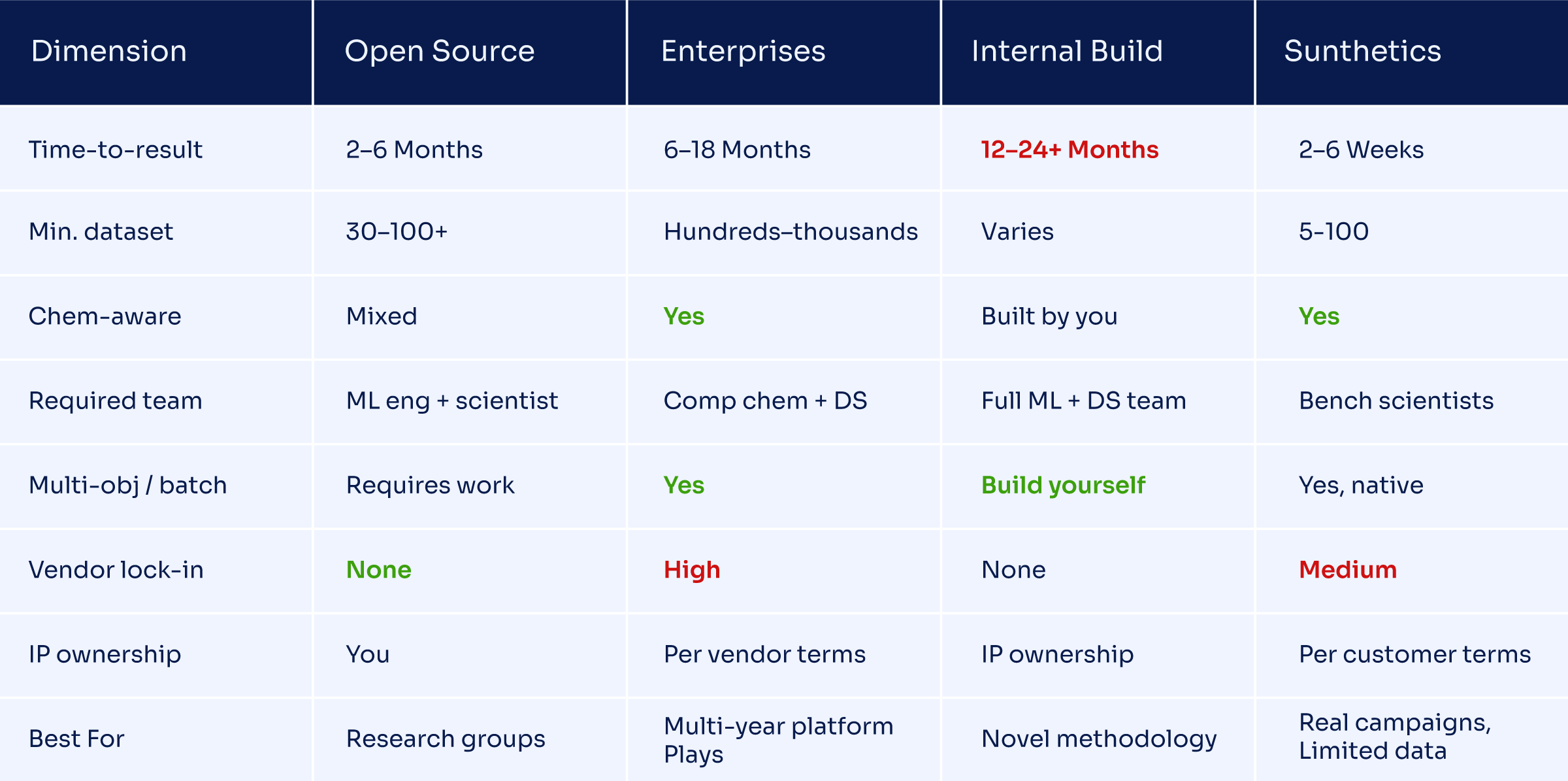
Side-by-Side: The Dimensions That Actually Matter
Features are easy to compare and often misleading. Time, data needs, team composition, and ownership are harder to compare and almost always more decisive.
Four Questions That Determine Which Category Fits Your Team
You do not need a forty-criterion vendor scorecard. You need honest answers to four questions.
1. What is your campaign cadence?
If your team needs a recommendation every two weeks, anything with a six-month integration timeline is disqualified before features matter.
2. What is your data volume?
If you have 30 experiments, you need a method that works on 30 experiments. Generic libraries can technically run on small data, but without chemistry-aware encoding the surrogate model will not generalize.
3. What does your team actually look like?
A platform that requires a deep computational team will fail in an organization that does not have one. Match the tool to the people who will use it daily, not the people who will procure it.
4. What are your IP and data constraints?
Some campaigns cannot move data outside the firewall. Some regulatory environments rule out cloud-hosted analysis. Surface these in week one of evaluation, not week ten.
Open source is the right answer if you have an ML team whose explicit mandate is to build BO infrastructure. It is the wrong answer if your team's job is to run R&D campaigns.
There is a recurring pattern worth naming. An R&D leader sees that capable open-source BO libraries exist, asks why their team should evaluate anything else, and assigns a junior engineer to "just use the open source." Six months later the campaign has stalled, the engineer has rebuilt half a product, and the R&D team has lost confidence in the method itself — not the tool, the method. The most damaging outcome is not the engineering time spent. It is the loss of organizational trust in Bayesian optimization as an approach.
Conclusion
The worst Bayesian optimization software decision is rarely the wrong vendor. It is the wrong category. A team that buys an enterprise platform when it needed campaign-level optimization will spend a year on integration. A team that picks open source when it needed a turnkey product will quietly rebuild a product over twelve months. A team that builds internally when it needed a vendor will spend a year of senior engineering time that should have gone to chemistry.
Pick the category first, then pick the tool. If you are evaluating where SuntheticsML fits your situation, contact us to run through your actual campaign data
Frequently Asked Questions
Is open source Bayesian optimization software better than a commercial platform?
They solve different problems. Open-source BO libraries are research-grade tools for ML engineers to build BO systems. SuntheticsML is a campaign tool for R&D teams to run optimizations. The comparison is closer to a deep-learning framework vs. a finished application than Library A vs. Library B.
Can a chemistry-aware open-source library replace a commercial platform?
For a single published-style campaign in an academic group, yes. For a recurring industrial workflow with constraints, multi-objective targets, batch parallelism, and audit trails, you will end up rebuilding most of a product around it.
When does it make sense to build Bayesian optimization software internally?
Three situations: novel methodology you want to defend as a competitive moat, many concurrent programs where a permanent ML function will operate the platform across all of them, or data residency rules that forbid external tooling.
Does SuntheticsML work alongside open-source BO tools?
Yes. Many customers run open-source BO internally for experimental ML work and SuntheticsML for production campaigns. The two are not in competition.
What is the fastest way to evaluate BO software?
Run a focused pilot on a real campaign with real data. Not a demo, not a benchmark dataset. Vendors that resist short, scoped pilots are usually signaling that their value depends on full-suite integration.
Further Reading
- Shields, B. J., et al. (2021). Bayesian reaction optimization as a tool for chemical synthesis. Nature, 590, 89–96.
- Frazier, P. I. (2018). A Tutorial on Bayesian Optimization. arXiv:1807.02811.
- Shahriari, B., et al. (2016). Taking the Human Out of the Loop: A Review of Bayesian Optimization. Proceedings of the IEEE, 104(1),148–175.