h1, h2, h3 { text-wrap: balance; } p { text-wrap: pretty; }

Redefining Electrochemical Optimization Through Small-Data Machine Learning

A U.S. chemical innovator unlocked a global maximum yield of 91.9% in their electrosynthesis process—using just 9 experiments, thanks to SuntheticsML's Bayesian Optimization.

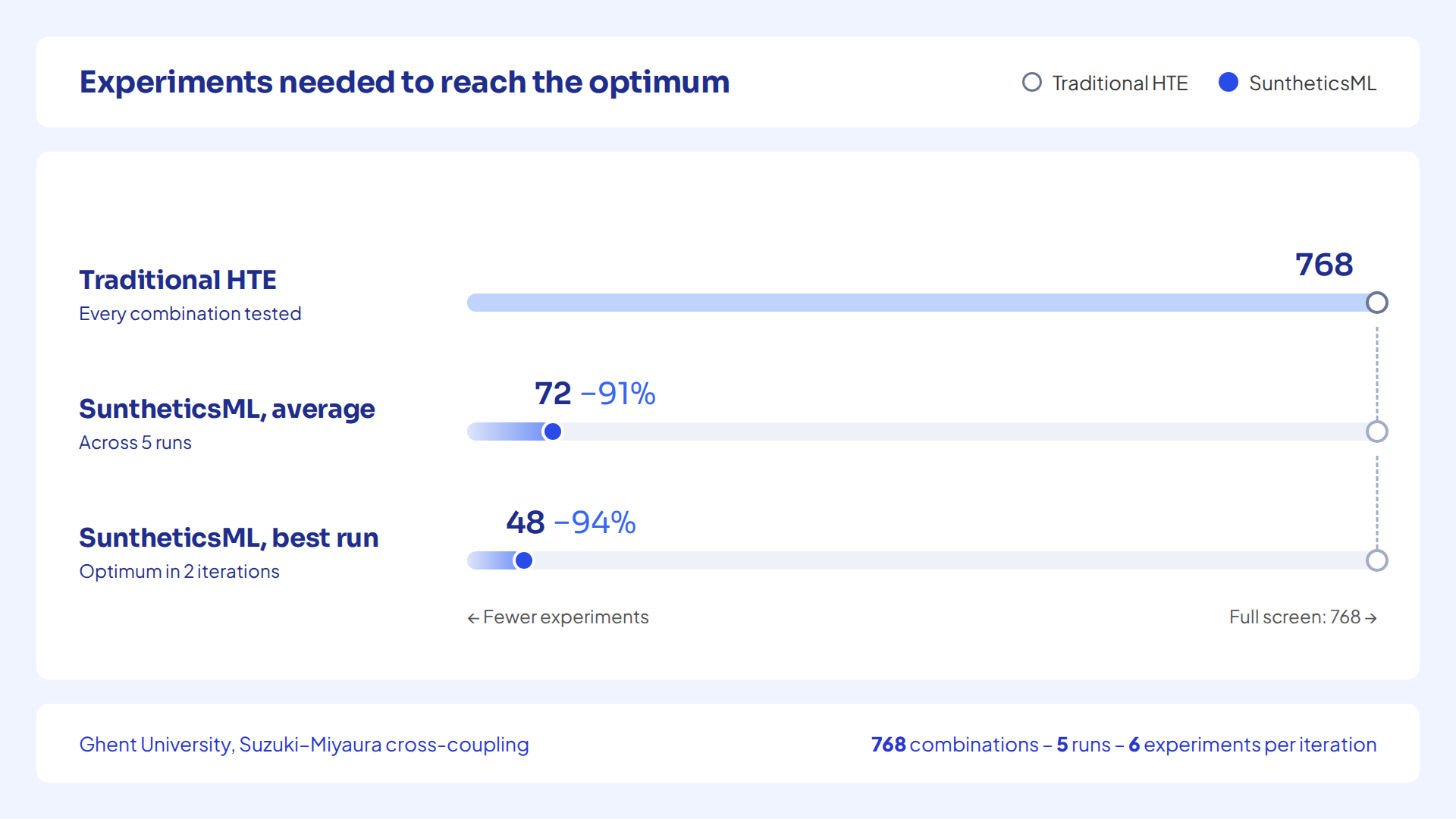
91%

Fewer experiments

94%

Fewer Experiments

2

iterations
Key Findings:

ML for Chemistry: Bayesian Optimization outperforms DoE in complex, high-dimensional systems.

Small Data, Big Results: SuntheticsML can deliver global maximums using as few as 5–9 experiments.

No-code + Insightful: A platform designed for chemists—no ML knowledge needed.

Speed to Discovery: Optimize chemical processes up to 15x faster, even with limited prior data.

Cost-Efficient R&D: Reduce time, resources, and iteration cycles without compromising scientific rigor.
Company Name

Pfizer

Category

Pharmaceutical Process Development

Published Date

October 29, 2026

Highlighted features / use cases
Active Learning
Categorical Optimization
Supervised Learning
Client

A leading U.S. pilot chemical plant focused on scaling organic electrochemical reactions. The client sought a scalable, precise, and cost-effective solution for optimizing continuous flow synthesis of specialty compounds.
Challenge

Electrochemical flow reactions are complex:

  • Byproduct networks, volatile selectivity curves, and flow-dependent variables make optimization slow and inefficient.
  • Traditional empirical methods required over 125 experiments, consuming months and yielding suboptimal results.
  • Even well-established DoE approaches demanded 18+ experiments and plateaued around 79.6% yield.
  • The best published result for this system using comparable equipment (non-platinum) was only 59% yield​.
Challenge
  • Identify optimal operating conditions (DMP concentration, flowrate, and current density) for the highest yield of TMBP.
  • Achieve this with minimal experimentation to enable faster R&D iterations and potential scale-up.
Goal
  • Identify optimal operating conditions (DMP concentration, flowrate, and current density) for the highest yield of TMBP.
  • Achieve this with minimal experimentation to enable faster R&D iterations and potential scale-up.
Approach & Solution

SuntheticsML was deployed to guide experimental design using a combination of:

  • Bayesian Optimization
  • Supervised + Active Learning
  • Automated ML algorithms—no coding required

Starting from just 5 data points, the model continuously refined predictions and suggested high-impact experiments across 3 iterations. Each iteration updated the predictive model, narrowing the space toward the global maximum.


This ML-guided workflow operates independently of initial experiment design, identifying optimum conditions with unmatched precision and speed.

Results & Metrics
  • Yield: Optimized to ~97.5%, matching a highly trusted prediction that matched the optimal found by Pfizer’s calibrated kinetic model
  • Impurities: Reduced in comparison to the optimal in the kinetic model optimization
  • Experiments: 15 → 14 (7% reduction compared to a highly efficient kinetic model)
  • Operating ranges identified: ramp rate, temperature, hold time
  • Search efficiency: ML-guided suggestions converged on the optimal operating window with minimal experimentation
  • Model robustness: SuntheticsML’s model proved accurate in the prediction of optimal conditions even with an added 5% error noise in the training data.

SuntheticsML further recommended optimal ranges for ramp rate, temperature, and hold period, even with additional tests for added system error and key training data points removed. Sunthetics located the ideal testing point in a shortened process that would normally have been hinderingly long through traditional methods.

Why it worked

"SuntheticsML mapped optimization space faster than any method they've tried. They reached a new performance record using a glassy carbon cell, with only 9 experiments."

‍