fewer experiments to reach optimal crystilizaiton conditions than traditional, statistical DoE. (J-Star Research)
reduction in experiment count for method development projects across CDMO partners.
faster time to specification versus traditional design of experiments approaches.
reduction in material consumption during early-stage process scouting.
Stamato Solutions & Meridion Technologies · Chimica Oggi – Chemistry Today, Vol. 43, 2025
Bayesian-optimization models built from over 80 experimental runs to characterize a spray freeze-drying process.
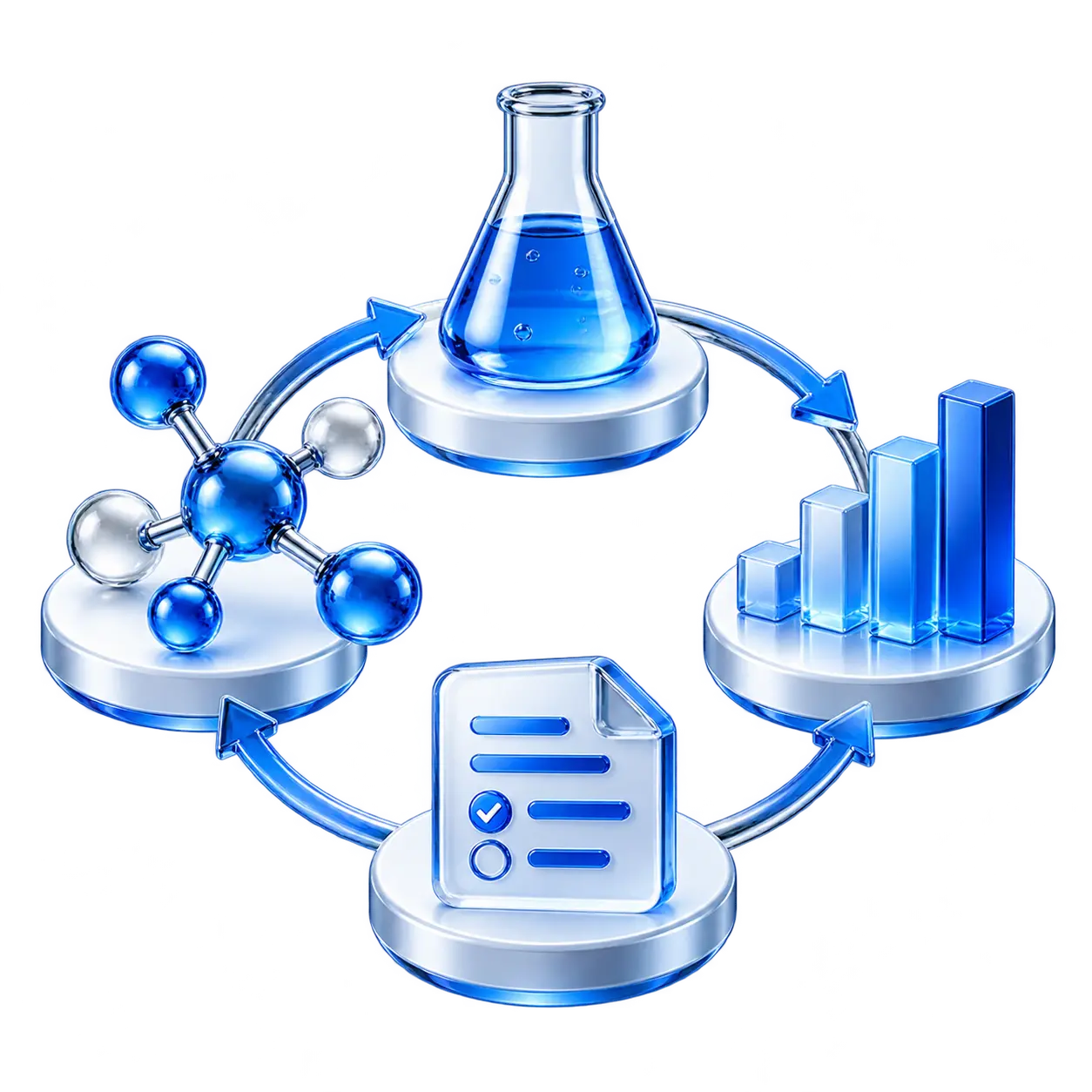
SuntheticsML plans one round of experiments at a time, using each result to decide what's worth running next, so you deliver results faster and protect your margins.

SuntheticsML, from Sunthetics, uses Bayesian optimization to recommend the next most informative experiment from a client program’s own data. It updates after each round instead of following a fixed DoE plan. In a retrospective validation, J-Star Research reached optimal crystallization conditions with 67% fewer experiments than traditional statistical DoE.
DoE commits to a full experimental plan before any results come in, and it works well for smaller, well-characterized systems. Bayesian optimization plans one round at a time, using each result to choose the next experiments, so it usually needs fewer runs as the number of variables and interactions grows. SuntheticsML can use existing DoE data as its starting point.
In SuntheticsML, each client program sits in its own isolated workspace. Models are trained only on that program’s data, so nothing learned for one sponsor carries into another’s campaign. Enterprise SSO and role-based access control who sees each program, and Sunthetics maintains a SOC 2 Type II report.
CDMO teams use SuntheticsML for process development, crystallization, HTE, lyophilization, scale-up, analytical methods, and formulation. Published work includes lyophilization with Stamato Solutions and Meridion Technologies and reaction screening with Boehringer Ingelheim.
SuntheticsML is a decision-support tool used during experimental planning, ahead of GMP execution. It recommends which experiments to run next, but it is not a GxP system of record. Scientists still execute, record, and review every experiment in their validated ELN or LIMS under existing quality procedures.