How SuntheticsML Guides Experiments Without Becoming a Black Box
Every scientist who's sat through an AI demo knows the feeling. The interface is slick, the predictions look confident and nobody in the room wants to ask the question out loud: Can I actually trust what this thing is telling me?
THE PROBLEM NOBODY WANTS TO ADMIT
It's not skepticism toward AI. It's something more specific.
Most researchers in process chemistry and formulation development have come across tools that give suggestions without clear explanations, models that can't clarify why they prefer one design option over another, and results that seem out of touch with actual chemistry.
In high-stakes domains like pharmaceutical process optimization, that transparency isn't just inconvenient, it's a liability. And this is precisely where most AI tools in chemical R&D underperform: not on raw capabilities, but on trust.
Can I actually trust what this thing is telling me?
The question every scientist in the room is thinking but no one asks out loud.
SuntheticsML™ is not the kind of AI platform most people associate with large, opaque, resource-intensive systems. It isa small-data AI/ML platform built specifically for chemical R&D, designed to generate useful experimental guidance starting with as few as 5 data points.
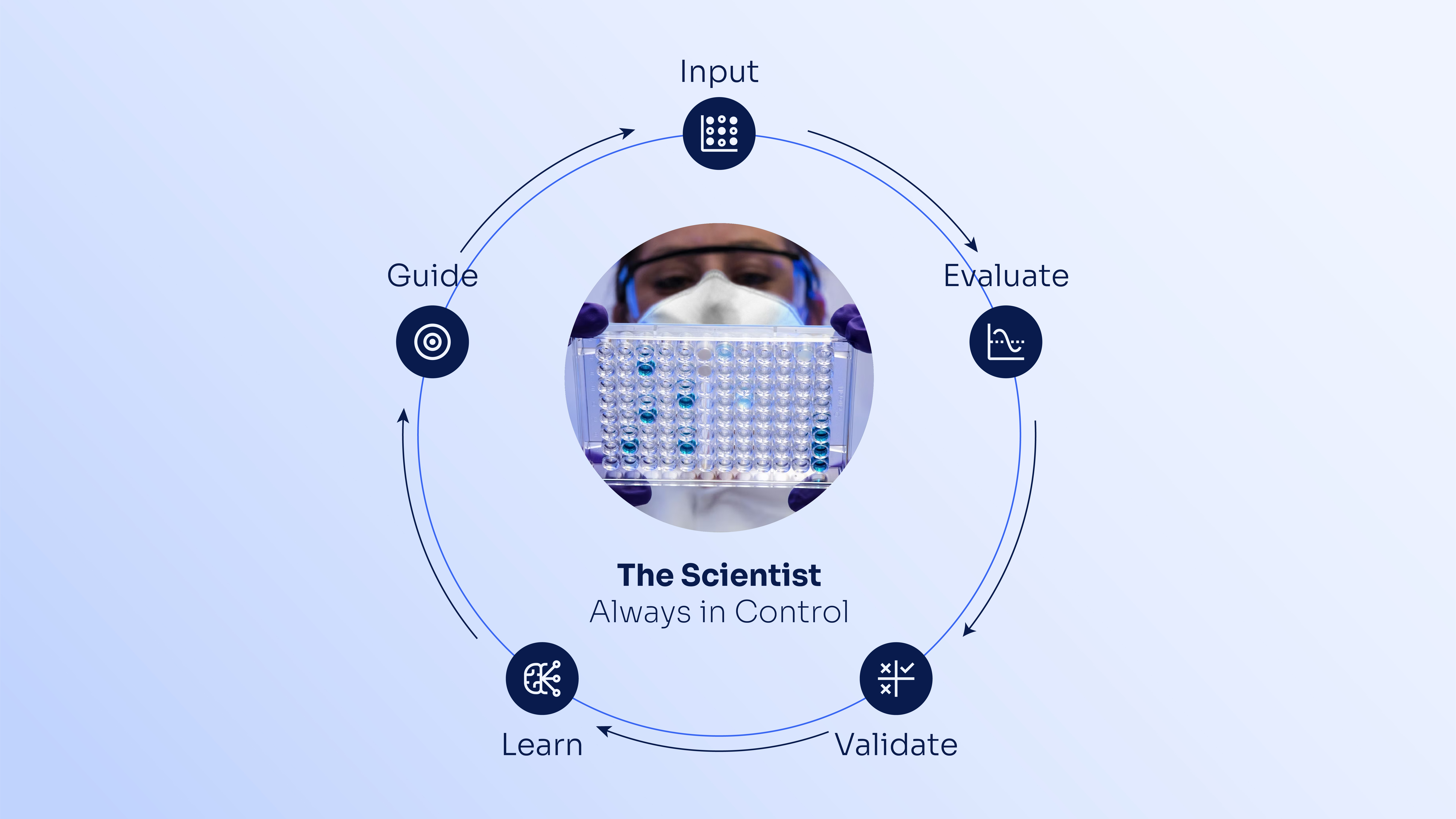
The goal is scientist-first: to help experienced researchers make better decisions faster, without surrendering key experimental decision-making to an algorithm they have no visibility into. Rather than treating AI as a replacement for domain expertise, Sunthetics ™functions like a chemical GPS™ for R&D: continuously evaluating, comparing, and refining multiple model perspectives so that every recommendation is grounded in data, not handed down from a single black box engine
THE OPERATING PHILOSOPHY
The next generation of formulation optimization software isn't trying to automate scientists out of the loop. It's designed to keep them more informed at every step
FIVE DIFFERENTIATORS
How the platform earns trust at every step.
These aren't just features, they're the mechanisms by which SuntheticsML™ stays transparent. Each one directly addresses a reason scientists distrust AI-guided optimization.
1. Modeling from sparse starting data
Starting with as few as 5 initial experiments, the platform begins mapping how inputs influence outcomes, where promising regions of the design space exist, and where uncertainty remains high. No 200-experiment investment before you get your first useful signal.
2. Multi-perspective system evaluation
Instead of forcing your data through a single rigid model, the platform evaluates it from multiple angles, compares how each interpretation performs, and identifies which ones are most reliable for your specific process. There is no universal "best model" in chemistry, only what best captures the behavior of the system in front of you.
3. Built-in model performance analysis
The system cross-references predictions across its different model versions, highlights where they converge and flags where they disagree. Uncertainty isn't hidden or smoothed over. It's surfaced as a signal, giving you an honest read on where SuntheticsML™ is confident and where it's still learning.
4. Active learning
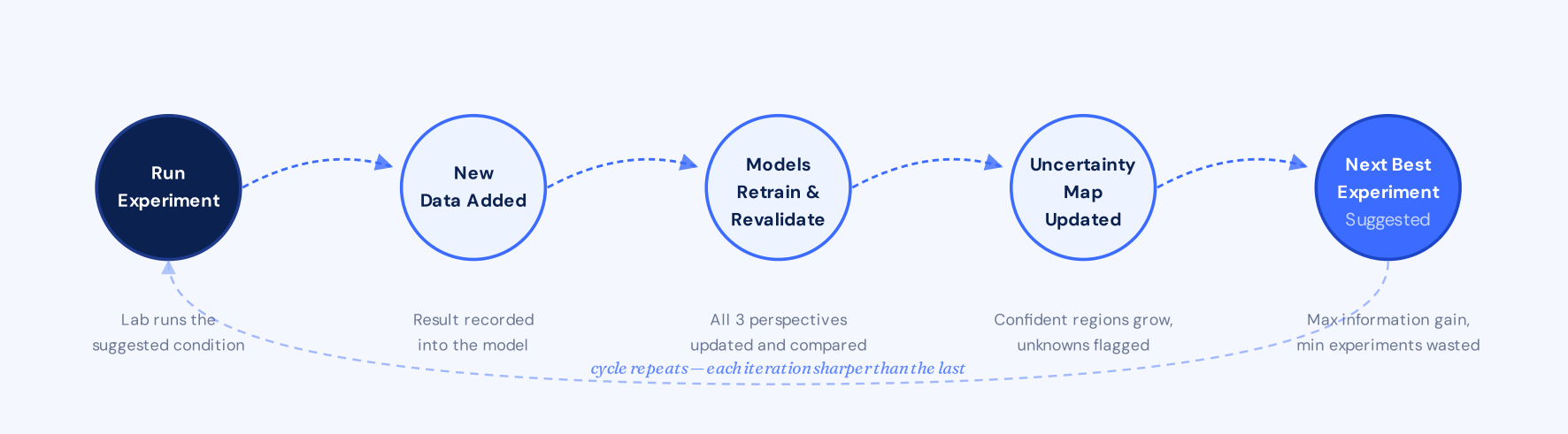
Every new experiment sharpens the system's understanding of your specific process. As you add more data, the system tightens variable relationships, clarifies input importance, and targets predictions more effectively. Overtime, the platform evolves from a general-purpose tool into a tailored decision layer for your workflow.
5. Actionable "next-experiment" guidance
Instead of static predictions, the platform tells you: "Here's the next experiment that will teach you the most, the fastest." Each recommendation is designed to maximize information gain, reduce uncertainty, and push you closer to optimal conditions, adapting intelligently at every step
VISUAL 01: MULTI-MODEL ARCHITECTURE
Why it's not a black box: you can see every model's reasoning.
The most common objection to AI-guided optimization is valid: if you can't see how the model works, you can't trust the result. SuntheticsML™ addresses this directly with a multi-model, self-validating architecture, not one opaque engine, but multiple competing perspectives that are continuously compared, validated, and surfaced to you.
The SuntheticsML™ Multi-Model Architecture
Three model perspectives on the same data: compared, validated, and surfaced transparently.
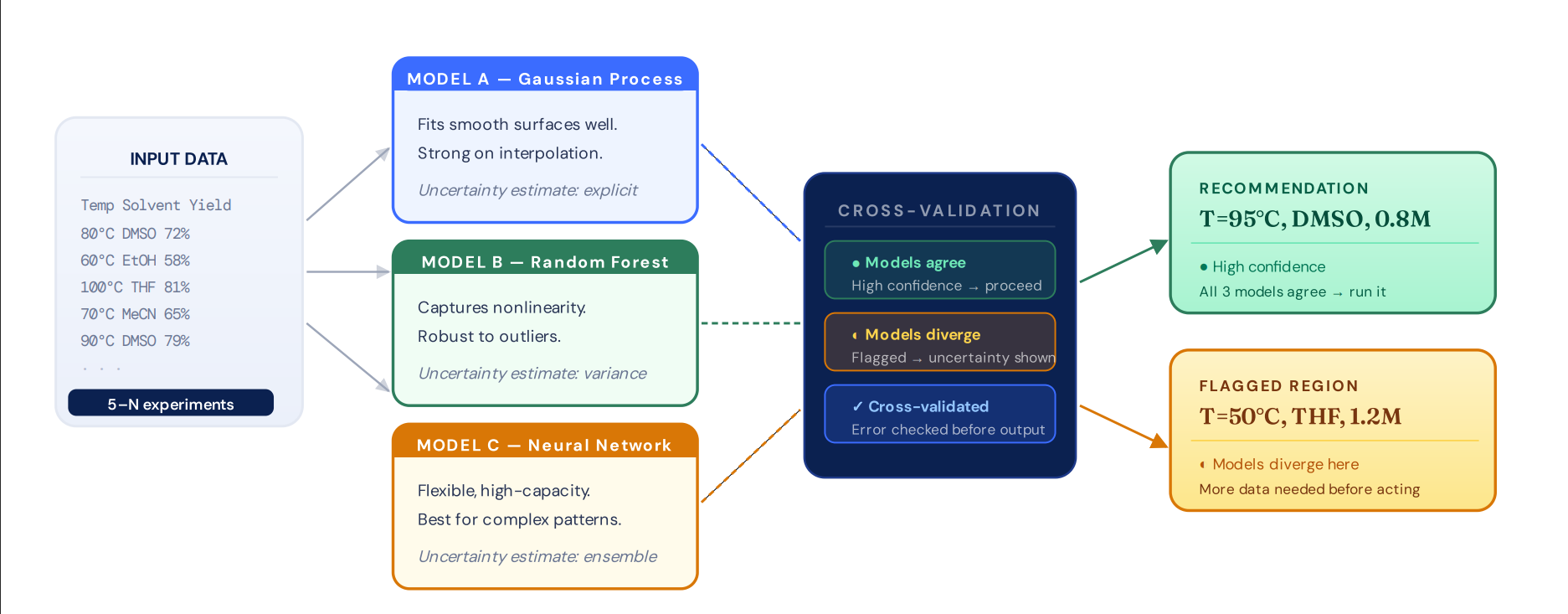
SuntheticsML™ runs multiple model perspectives simultaneously. Where they agree, recommendations come with high confidence. Where they diverge, uncertainty is flagged explicitly to give you an honest read on what the system knows and what it's still learning. This is the opposite of a black box.
VISUAL 02: DOE VS BO NAVIGATION
DOE explores. Bayesian optimization navigates.
Weighing DOE against Bayesian optimization isn't an either/or conversation. DOE remains indispensable for structured system characterization and regulatory documentation. But when speed, sample efficiency, and adaptability are the priority, BO approaches consistently outperform static experimental plans.
Two Strategies, One Design Space
Same number of experiments, fundamentally different information gain.
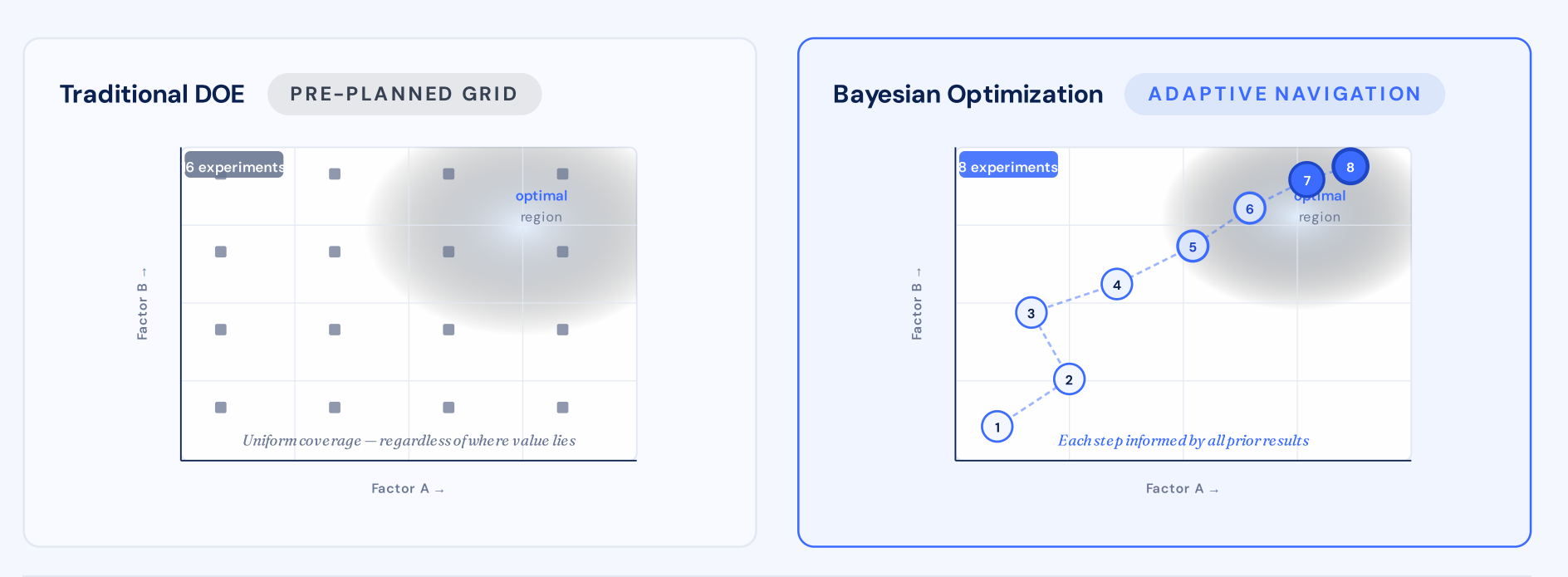
DOE commits resources uniformly across the design space before you know where value lies. Bayesian optimization starts exploring, then converges toward optimal regions — spending experiments where they teach you most. Same budget, fundamentally different intelligence gain.
The Active Learning Loop
How each experiment makes the next recommendation smarter
COVERAGE AND CONFIDENCE
Fewer experiments get the headlines. The deeper shift is subtler.
It's the confidence that you're exploring the right regions of design space, that you're not leaving better solutions undiscovered in some corner you never tested, and that every experiment you run has a clear, legitimate purpose. That's what separates modern process optimization from traditional trial-and-error: not just efficiency, but directionality
Put simply: DOE explores. Bayesian optimization navigates. In resource constrained R&D environments, BO-informed navigation wins.
THE REAL DIFFERENCE
On model transparency
The most common objection to AI-guided optimization is simple: If I do not understand how the model works, I cannot trust the result. That concern is valid. SuntheticsML™ is not a black-box solution. It is built with a multi-model, self-validating architecture that gives scientists visibility into how recommendations are generated, showing where models agree, where they diverge, and where more data is needed.
Rather than asking scientists to blindly trust a single model, the platform is designed to support transparent, informed decision-making while keeping the scientist in control at every step. Your scientists run the experiments, interpret the results, and make the final calls. SuntheticsML™ amplifies your expertise, it doesn't overwrite it.
THE BOTTOM LINE
True optimization is not just about identifying better conditions. It is about moving forward with confidence, knowing each next step is grounded in data and direction
What you get:
- Recommendations you can see the reasoning behind
- Confidence signals, not just point predictions
- Flagged uncertainty — no false precision
- Active learning that improves with every run
What stays with you :
- Final experimental decisions
- Scientific interpretation of results
- Domain expertise the model can't replace
- Ownership of IP and process knowledge